
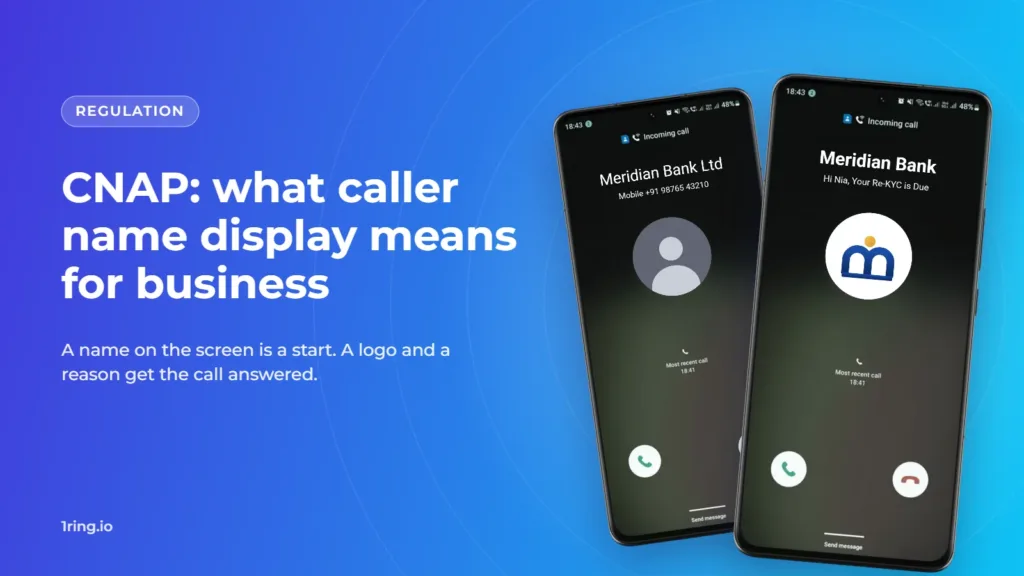
Since 1 November 2026, when someone in India gets a call on a 4G or 5G network from a number they haven’t saved, their phone shows a name. Not a name from Truecaller. A name from the calling operator’s own records. That’s CNAP, and for any business that calls customers, it changes what they see the moment your call arrives.
This guide explains what CNAP shows, where the name comes from, how a business registers the name it wants customers to see, what CNAP still can’t do, and what to do about it this quarter.
In this guide
- The short answer
- What is CNAP?
- How we got here
- What your customers see when you call
- How a business registers its preferred name
- What CNAP doesn’t do
- CNAP vs Truecaller vs app-based branding
- What to do this quarter
- Frequently asked questions
The short answer
CNAP (Calling Name Presentation) is a network service that shows the caller’s name, taken from the calling operator’s subscriber records, on incoming calls. DoT made it mandatory on 4G and higher networks from 1 November 2026, switched on by default. Businesses with bulk connections can register a verified preferred name tied to a registered trademark or GST trade name. CNAP shows text only, with no logo and no reason for the call, and it doesn’t remove spam labels from caller ID apps.
What is CNAP?
CNAP is caller ID with a name attached, run by the telecom operators themselves. When a call comes in, the receiving phone shows the number and a name drawn from the originating operator’s subscriber data, the same records built from customer application forms and KYC at the time of connection.
According to Voice&Data’s report on the DoT order, a few rules shape what customers see:
- It’s on by default. Subscribers don’t need to request it.
- Saved contacts win. If the customer has saved your number, they see their own label.
- Calls from abroad show “International Call”.
- Subscribers who use CLIR (calling line identification restriction) don’t have their name shown.
- Operators must not keep the retrieved caller names after the call ends.
How we got here
TRAI recommended CNAP as a way to curb spam and fraud calls. DoT first aimed for a nationwide rollout by March 2026, with Vodafone Idea, Bharti Airtel and Reliance Jio running pilots in some northern circles, according to Business Standard in October 2025. Operators also had to run interoperability tests so names display correctly when a call crosses networks.
That date slipped. A DoT circular dated 13 October 2026 set 1 November 2026 as the start date for 4G and higher networks, as Outlook Money reported. 2G, 3G and fixed-line networks will be considered separately.
What your customers see when you call
This is where businesses get caught out. CNAP shows the name on record for the number, so the question is: whose name is on your numbers?
- If a number is registered to your company and you haven’t set a preferred name, customers see the name in the operator’s records. That may be your full legal entity name, which customers may not recognise.
- If a number was taken in a vendor’s name, such as a BPO, collections agency or CPaaS provider, customers may see the vendor.
- If you call from many numbers, they may not all show the same name, which looks odd to a customer who gets two calls in a week.
None of this is a problem if you fix it early. It becomes one when a customer sees an unfamiliar name on a call claiming to be their bank.
How a business registers its preferred name
DoT’s rules let business and bulk connections display a verified “preferred name” instead of the default record. Per the reporting on the circular, that name has to be a trademark registered in your name or the trade name on your GST registration, and operators verify the documents before it goes live. New connections record the name at signup. Existing connections need an update through the operator.
Operators also have to resolve complaints about incorrect names, so if a number shows the wrong name, raise it with the operator that issued it.
Practical steps:
- List every outbound number, including your 1600 and 140 series numbers, and note which operator issued each one and whose name it’s registered to.
- Decide the one name you want customers to see. Short and recognisable beats the full legal name.
- Check that the name matches a registered trademark or your GST trade name, because that’s what operators will verify against.
- Submit the change with each operator and check it with test calls from phones on Jio, Airtel and Vi.
What CNAP doesn’t do
CNAP is a real step forward, and it’s free of the crowd-sourcing problems that caller ID apps have. But it was built to show a name, nothing more.
- No logo. It’s text on the call screen.
- No reason for the call. The customer still doesn’t know whether you’re calling about a fraud alert or a cross-sell.
- No personalisation. Every customer sees the same name, in the same language.
- No protection from spam labels. If Truecaller or the phone’s own filter has labelled your number, that label still shows.
- No guarantee of safety. As Outlook Money put it, a displayed name doesn’t guarantee a call is safe. A scammer calling from their own SIM shows their own name, which is useful, but they can still claim to be you once the customer answers.
- 4G and 5G only, for now. 2G, 3G and landlines come later.
CNAP vs Truecaller vs app-based branding
| CNAP | Truecaller for Business | App-based branding (1Ring) | |
|---|---|---|---|
| What customers see | A name, as text | Name, logo, verified badge, category; reason tag on some plans | Name, logo, a personal reason for the call and a verification mark |
| Who sees it | 4G and 5G subscribers, on all networks | People with Truecaller installed | Customers who have your app, on Android and iPhone |
| Where the name comes from | Operator subscriber records or your verified preferred name | Truecaller’s verification of your business | Your registered brand, bound to each call |
| Per-call verification | No | No | Yes, a single-use token per call |
These aren’t either/or. CNAP is now the baseline every customer gets. On top of it, 1Ring branded caller ID adds your logo and a personal reason for the call for customers who have your app, and falls back to other branding for everyone else. Our full comparison of branded caller ID options in India goes through each one in detail, and Assertion’s series on what Airtel is doing about call trust covers the operator side.
What to do this quarter
- Audit the CNAP name on every outbound number and fix the wrong ones.
- Register a preferred name backed by your trademark or GST trade name.
- Make sure numbers used by vendors on your behalf show your brand, not theirs.
- Tell customers what name and numbers your genuine calls come from.
- For the calls that matter most, add your logo and the reason for the call through your app, so customers know why you’re calling before they answer.
If you’re in banking or financial services, read this alongside our guide to the 1600 series, because the two rules work together: the series tells customers the call is from a regulated firm, and CNAP tells them which one.
Frequently asked questions
What is CNAP in India?
CNAP (Calling Name Presentation) is a network service that shows the caller’s name, from the calling operator’s subscriber records, on incoming calls. DoT made it mandatory on 4G and higher networks from 1 November 2026.
Is CNAP mandatory?
Yes, for operators on 4G and higher networks from 1 November 2026, and it’s switched on by default for subscribers. 2G, 3G and fixed lines will be considered separately.
Where does the CNAP name come from?
From the originating operator’s subscriber records, built from customer application forms and KYC. Business connections can instead show a verified preferred name.
How can a business show its brand name on CNAP?
Business and bulk connections can register a verified preferred name with their operator. It must be a trademark registered in the business’s name or the trade name on its GST registration, and the operator verifies the documents.
Does CNAP show a logo or the reason for a call?
No. CNAP shows a name as text only. A logo and a personal reason for the call need a branding layer such as app-based branded caller ID.
Does CNAP replace Truecaller?
No. CNAP comes from the network, so it works without any app, but Truecaller and the phone’s own spam filter can still add their own labels on top.
Keep reading
- Branded Caller ID in India: Every Option Compared
- TRAI’s 1600 Series Explained
- Business Number Showing as Spam? How to Fix It
- Assertion: Trust the Call, a series on verified business caller IDs
Go beyond a name on the screen
In 30 minutes we place a live branded call on your own phone, with your logo and a personal reason for calling, and map 1Ring to your workflows.